


Visa Application Process
Starting a business or expanding operations in Japan requires obtaining the appropriate Status of Residence or visa.
Below is an overview of the main visa categories relevant to entrepreneurs, business managers, and foreign employees, as well as the general application process.
Visa for Business Operations
Although it is technically possible for overseas residents to establish a company in Japan because there are no residency requirements, in practice this can be difficult. In many cases, tasks such as securing office space and opening a corporate bank account require actual residence in Japan and holding an appropriate status of residence.
Given these factors, there are essentially two main approaches for foreign nationals who are not residing in Japan, or who do not hold an appropriate status of residence, to establish a company in Japan.
- Obtain a status of residence that permits entrepreneurial activities, establish a company, then transition to a long-term Business Manager visa to operate the company while residing in Japan.
- Appoint a Japanese national, or a person residing in Japan with an applicable status of residence, as the representative who assumes management and supervisory responsibilities. This representative completes the office lease contract, company registration procedures, corporate account opening, and other necessary tasks. Business instructions can be given from overseas.
STEP can support the smooth acquisition of status of residence by providing guidance on residence status and application procedures, including introductions to specialists such as administrative scriveners and free consultations with them.
1. Types of visas for starting a business in Japan
The primary statuses of residence that allow for entrepreneurial activities in Japan are listed below. Application requirements, required documents, period of stay, and permitted activities vary depending on the specific status of residence.
- Business Manager Visa
- Foreign Entrepreneurship Promotion Project (Startup Visa): Ministry of Economy, Trade and Industry (METI)
- Foreign Entrepreneurship Promotion Project (Startup Visa): National Strategic Special Zone (Cabinet Office)
- Japan System for Future Creation Individual Visa (J-Find)
- Special Highly-Skilled Professionals System (J-Skip)
- Highly Skilled Professional (i) and (ii)
- Permanent Resident, Long-Term Resident, Spouse or Child of Japanese National or Permanent Resident
1-1. Comparison of the requirements for major visa types for starting a business

1-2. Business Manager Visa
1-2-1. Basic Requirements
- Business Location: Establish a business office in Japan.
- Capital Investment: Capital or total investment amount must be 30 million yen or more;
OR
Full-time Employment: Employ at least one full-time worker who has an eligible status of residence (Japanese nationals, permanent residents, spouses of permanent residents, spouses of Japanese nationals, long-term residents, certain highly skilled professionals) - Experience: At least three years of relevant practical experience in business management or administration, including time spent studying at the master’s degree level or higher.
- Japanese Language Proficiency: Must have Japanese language ability equivalent to or higher than the Japanese Language Proficiency Test (JLPT) N2 level.
- Remuneration: Remuneration equivalent to or higher than what a Japanese national would receive for similar work (guideline: 200,000 yen or more)
- Business Plan: Must be verified by management professionals (e.g., SME management consultants, certified public accountants, or tax accountants) and demonstrate business sustainability.
1-2-2. Period of Stay
Period of Stay: 5 years, 3 years, 1 year, 4 months, or 3 months.
The Immigration Bureau determines the period of stay based on a comprehensive assessment of factors such as the intended working period stated in the application, the requested period of stay, and the scale and stability of the company. Applicants cannot specify the period of stay. For new companies, a period of stay of 1 year is often granted.
1-2-3. Documents to submit for when applying for a Certificate of Eligibility (COE)
The required documents fall into two categories: individual-related documents and company-related documents. Below are examples of typically required documents for applications, though requirements may vary by case.
1-2-3-1. Documents relating to the individual applicant
- Application form (completed form of Application for Certificate of Eligibility)
- Passport
- Photograph
- Resume: A detailed resume highlighting relevant professional experience and qualifications
1-2-3-2. Documents relating to the company
- Company Registration Documents: Proof of company registration in Japan
- Business Plan: A detailed business plan that includes business objectives, market strategies, and financial forecasts
- Office lease agreement: Proof of office space
- Resident certificates of full-time employees and balance sheets : Proof of business scale
- Japanese language proficiency test (JLPT) certificate: Proof of Japanese language ability
- Degree certification(s) and resume: Proof of career background
- Remuneration-related documents: Documents such as the notification of salary payment
- Financial statements: E.g., bank statements to show availability of funds
- Employment contract(s): List of full-time employees
- Other supporting documents depending on the company size
#For details on required documents, please refer to the Immigration Services Agency website:
https://www.moj.go.jp/isa/applications/status/businessmanager.html
1-3. Hokkaido Startup Visa
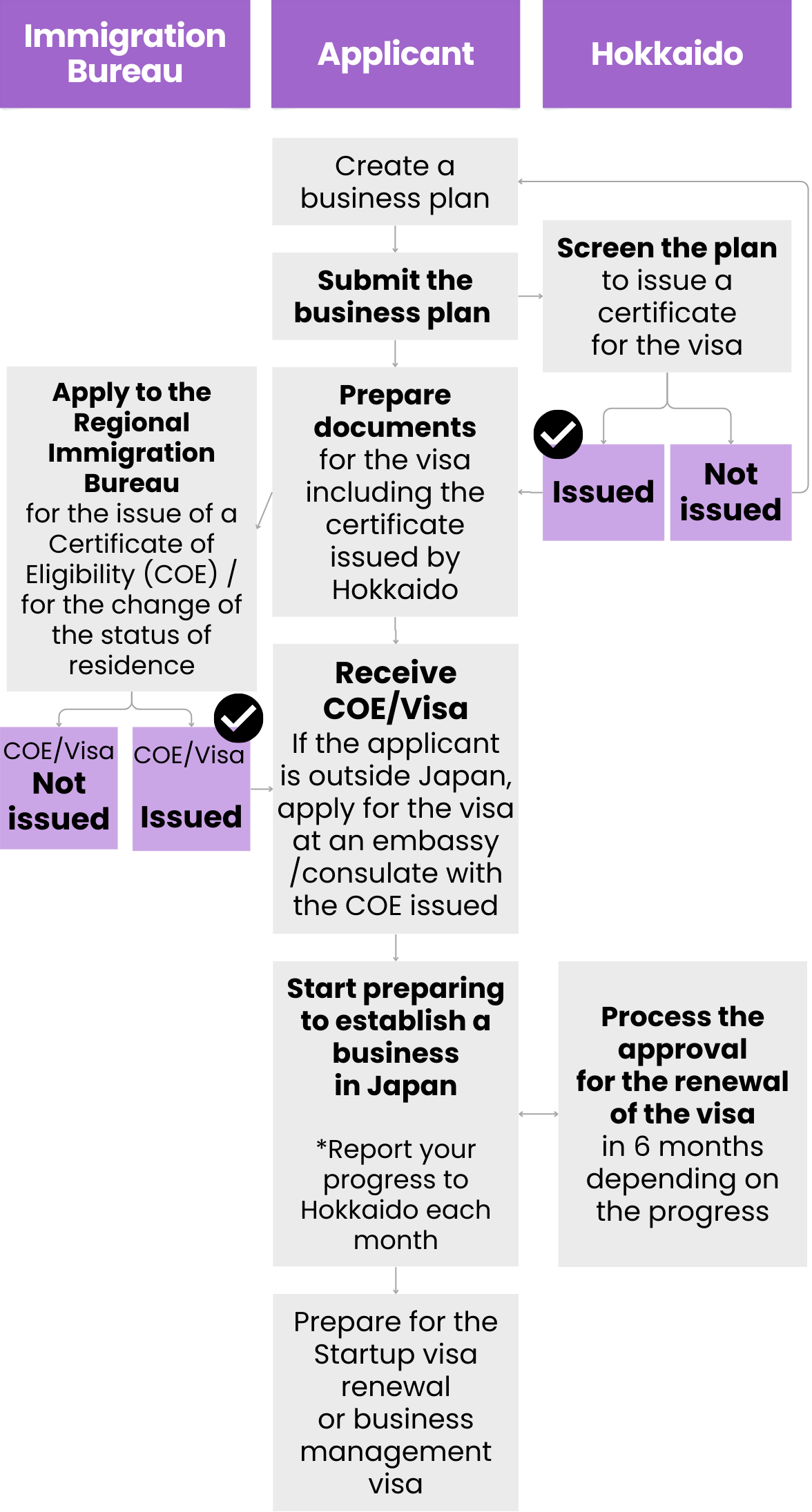
The Hokkaido Startup Visa allows entrepreneurs to begin their activities while deferring, for up to one year, the usual requirements for obtaining Business Manager status of residence. Holding this Designated Activities status of residence makes it easier to open a corporate bank account and lease an office. It serves as a preliminary visa that can lead to obtaining a Business Manager visa after establishing a corporation.
1-3-1. Basic requirements
- A foreign national
- A person who intends to start a new business in Hokkaido
1-3-2. Period of Stay
- Period of Stay: Up to 1 year (renewable once, with initial 6-month period plus 6-month extension)
1-3-3. Eligible businesses
- Agriculture, forestry and fisheries businesses that support local communities
- Food-related industries utilizing regional resources
- Tourism businesses that develop Hokkaido as a premier destination
- High-value manufacturing industries
- Industries adapting to market demands and other governor-approved businesses
1-3-4. Documents to be submitted (new application)
- New business implementation plan
- Planned entrepreneurial activities
- Revenue, expenditure and financing plan
- Resume
- Proof of one year’s residence in Japan (rental agreement or application)
- Proof of funds for one year in Japan (bank statements)
- Additional documents (degrees, work history) where applicable
- Copy of applicant’s passport
- Other documents deemed necessary by the governor
#For details, please refer to the Hokkaido Government website: https://www.pref.hokkaido.lg.jp/kz/dxs/toppage_english.html
1-3-5. Application process for the Hokkaido Startup Visa
2. Status of residence for foreign employees not engaged in management
For foreign nationals to work at a company established in Japan without being involved in management, there are primarily two types of status of residence: Engineer/Specialist in Humanities/International Services and Intra-company Transferee.
2-1. Comparison of key features of employee visas

2-2. Engineer/Specialist in Humanities/International Services
This status permits foreigners to be employed as engineers or office workers in companies. However, the work is limited to the following categories, or to comprehensive duties spanning these fields. Entrepreneurship, management, and administration are not permitted.
2-2-1. Main types of work permitted
- Engineer
Technical work in science and engineering fields. (e.g.,IT engineers, programmers, mechanical engineers) - Specialist in Humanities
Work in fields such as law, economics, and sociology. - International Services
Work requiring foreign cultural knowledge. (E.g., translators, designers, language teachers, marketers, trade)
2-2-2. Basic requirements
Requirements for individuals
- Education/work experience: Must have relevant work experience (10 years for Engineering/Humanities, 3 years for International Services) or university degree in a relevant field.
- Salary: Approx. ¥200,000/month, equal to or above Japanese national equivalent.
Requirements for companies
- Employer Requirements: Must be financially stable with adequate facilities and good standing.
- Other considerations: Sufficient work volume, appropriate workplace and office, and no record of misconduct.
2-2-3. Documents to be submitted
Required documents are divided into those related to the applicant and those related to the employing organization. Particularly for documents concerning the employing organization, the documents required may vary significantly depending on company size.
Documents relating to the applicant
- Application form for certificate of eligibility
- Photos
- Proof of specialized knowledge where applicable (if graduated from a vocational school with Specialist or Advanced Specialist title)
Documents relating to the employing organization
General categories

Example of required documents by category

#For details on required documents, please refer to the Immigration Services Agency website. https://www.moj.go.jp/isa/applications/status/gijinkoku.html
2-3. Intra-company Transferee
This status applies to transfers between related companies, and permits the following types of transfers:
There are two main types of intra-company transfers:
- From a foreign company’s overseas office to their branch/affiliate in Japan
- From a Japanese company’s overseas branch/affiliate to their office in Japan
This status has specific job restrictions. Holders can only engage in activities similar to those permitted under Engineer/Specialist in Humanities/International Services. This means entrepreneurship, management, and administration activities are not permitted.
2-3-1. Basic requirements
To obtain an ‘Intra-company Transferee Visa’, the applicant must meet all of the following requirements.
- Have continuously engaged in work that falls under the Engineer/Specialist in Humanities/International Services status of residence at the overseas head office,, branch, or other office, for at least one year immediately before the transfer.
- Continue to engage in work that falls under the Engineer/Specialist in Humanities/International Services status of residence after the transfer.
- Receive remuneration equal to or greater than that which a Japanese national would receive for the same work (as a guideline, at least 200,000 yen per month).
2-3-2. Documents to be submitted
As with Engineer/Specialist in Humanities/International Services, the necessary documents are divided into those relating to the applicant and those relating to the employing organization.
Documents submitted by the applicant
- Application form for certificate of eligibility
- Photograph
- Resume
- Document issued by the transferring overseas company certifying the applicant’s career
Documents to be submitted by the organization
General classifications of institutions are the same as for Engineer/Specialist in Humanities/International Services.
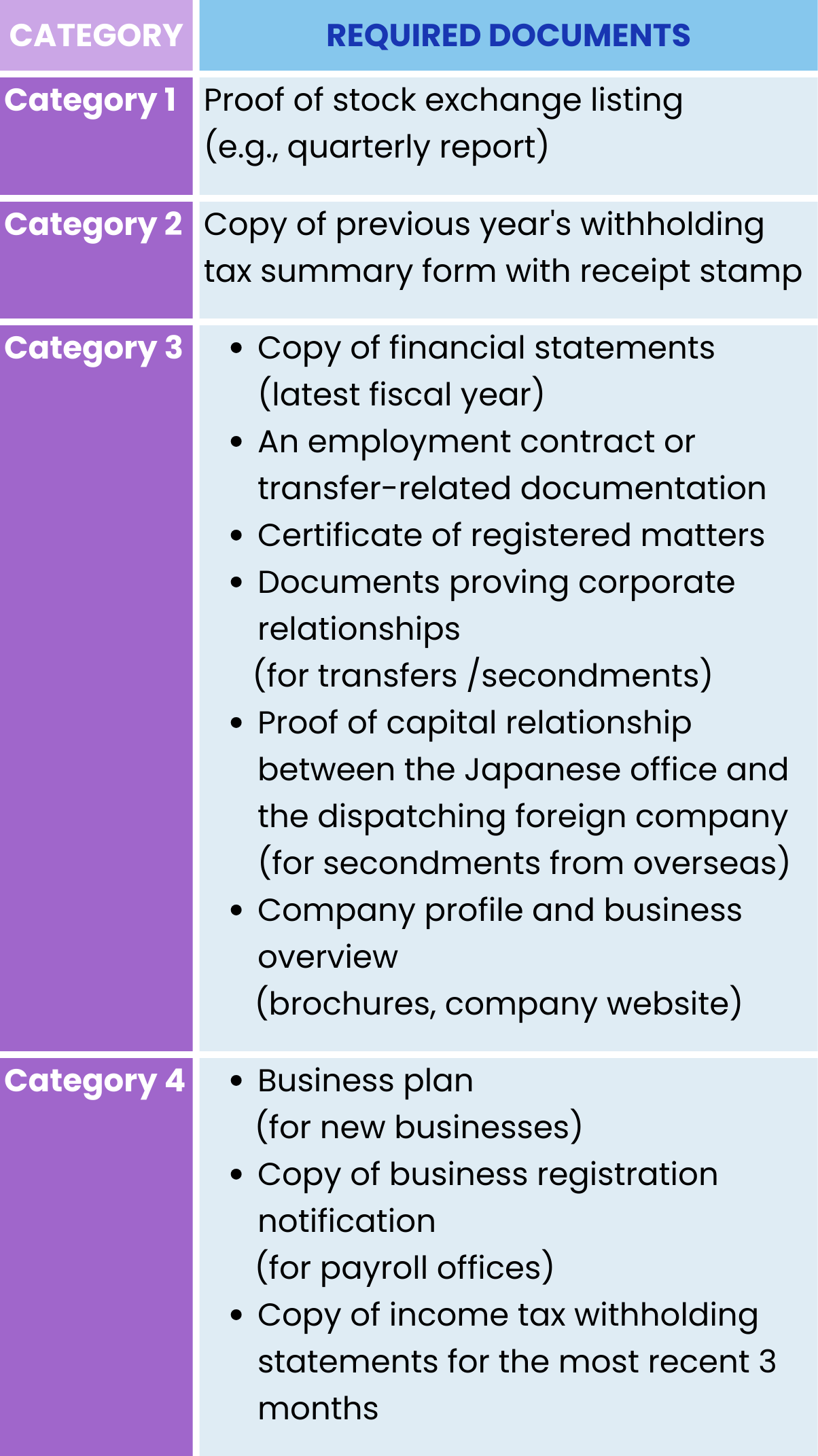
#For details on required documents, please refer to the Immigration Services Agency website.
https://www.moj.go.jp/isa/applications/status/intracompanytransfee.html
3. General process of obtaining a visa
To obtain a visa for Japan, applicants must first apply for and undergo examination of a Certificate of Eligibility (COE) at the Regional Immigration Services Bureau that has jurisdiction over the planned place of stay. Once the COE is issued, the applicant applies for a visa at the Japanese embassy or consulate in their country of residence.
For visa applications made from within Japan, the certificate can be issued by the Immigration Services Agency, so there is no need to visit a Japanese embassy abroad.
When overseas residents apply for and obtain a COE, they must submit the application and receive it at a Regional Immigration Services Bureau within Japan. Cooperation of a proxy residing in Japan is therefore required. STEP works with administrative scriveners who can handle the application procedures for status of residence, including COE acquisition, creating an environment where foreign entrepreneurs can prepare for their status of residence with peace of mind.
Visa application process for Japan