

Settling into Life in Sapporo
After arriving in Japan, several administrative and practical procedures must be completed within specific timeframes. This section outlines the key steps required to begin daily life smoothly in Sapporo.
Procedures and Preparations for Settling into Life in Sapporo
To start living in Japan, certain procedures must be completed within a set period after entering the country. STEP provides life-setup support services to help with these initial requirements. This includes resident registration at ward offices in Sapporo City, creating an ‘inkan’ (personal seal) required for opening a bank account and other important procedures, and assistance with finding housing.
Additionally, the Sapporo Foreign Residents’ Consultation Service (https://www.sapporolife.info/en/) also provides useful information about living in Sapporo. The service also offers a range of support services for foreign residents.
1. Procedures After Arriving in Sapporo
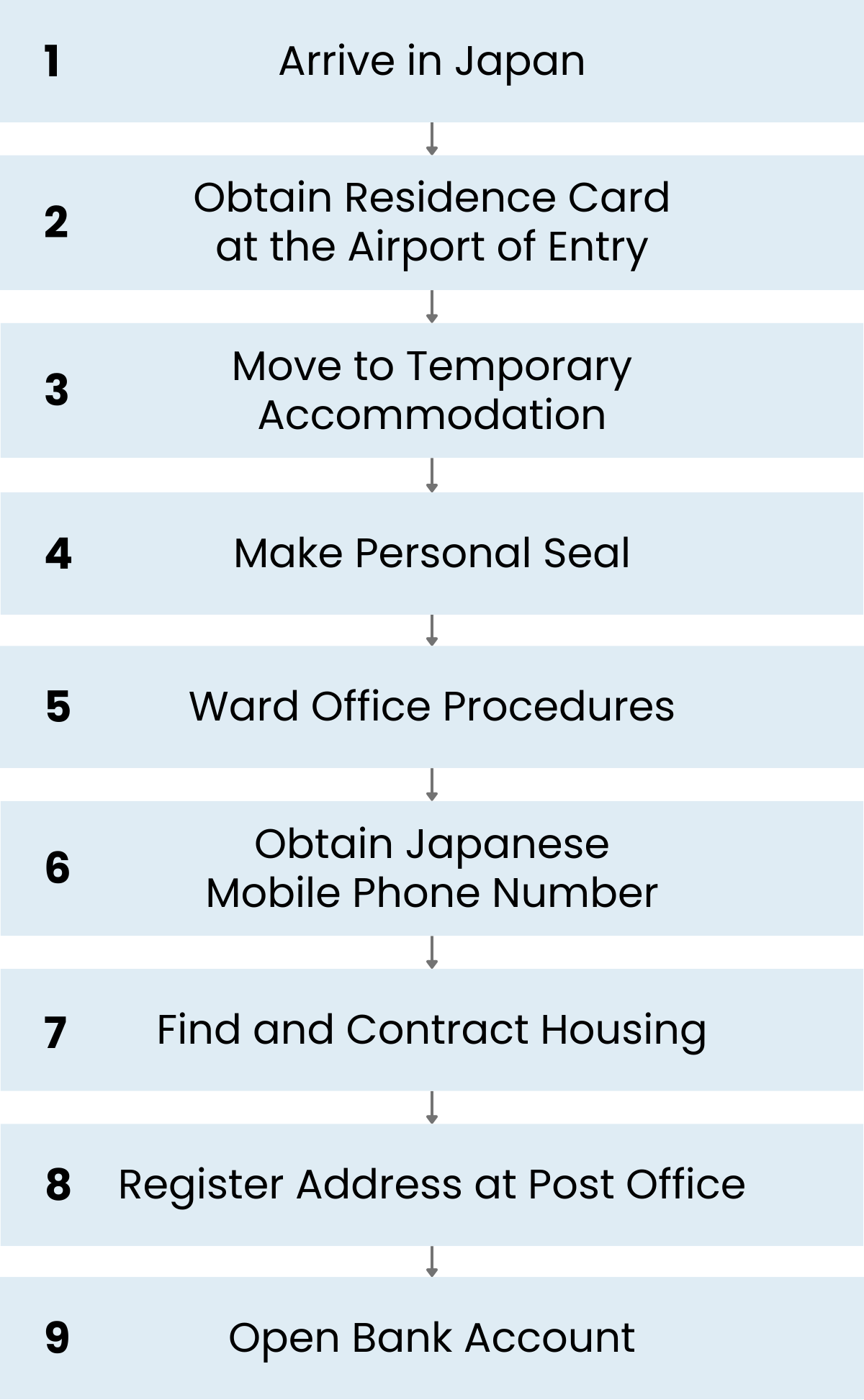
The following procedures should be completed shortly after arrival.
2. Residence Card
What is a Residence Card (“zairyuu” card)?
A Residence Card is issued to mid- to long-term foreign residents when they receive permission to land in Japan. It is usually issued at ports of entry such as airports.
Why does it matter?
The Residence Card serves as official identification for foreign nationals living in Japan. It is linked to your residence status and must be carried and handled with care.
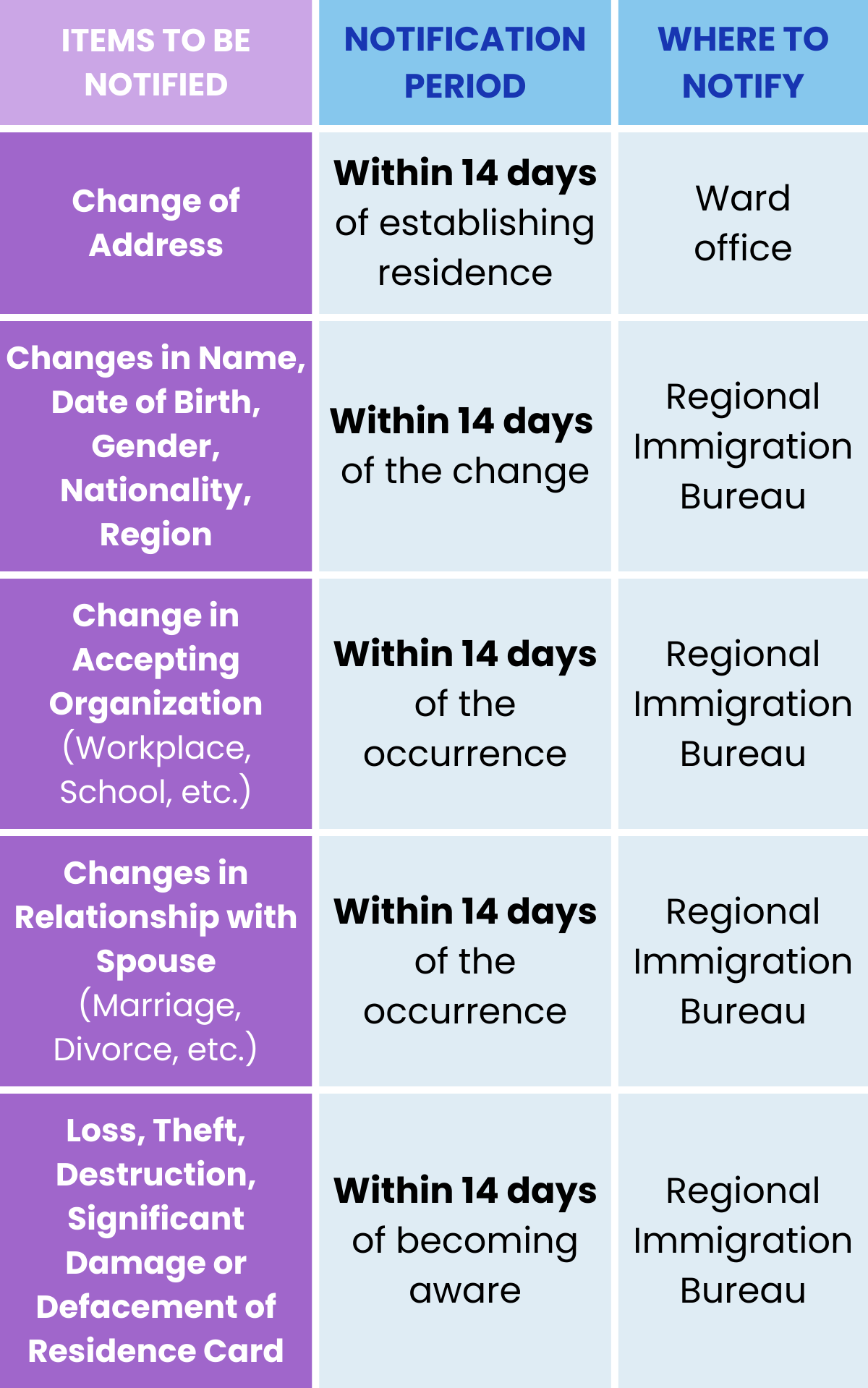
In the following cases, you need to notify your regional Immigration Bureau or municipality to update your Residence Card information:
3. Creating a Personal Seal (“inkan”)
What is a personal seal?
A personal seal (called “inkan” or “hanko” in Japanese) is a stamp of your name and is used as a signature in Japanese culture. It is used for various contracts such as real estate contracting, bank procedures, and even receiving packages.
Why do I need one?
In business contexts, it is also frequently required for the aforementioned purposes and various documents including invoices. After arriving in Japan, you should create your personal seal as soon as possible.
3-1. Three Main Roles of Personal Seals in Japan
- Personal official signature
- Corporate official signature
- Document approval
3-2. Important Points for Foreigners Creating Personal Seals
- For bank seals, you can choose to have your name in alphabet letters, “katakana”, or “kanji” characters.
- The standard size for bank seals is a round seal with a diameter of 12-13.5mm.
- For seal registration at the ward office, you must register using the name exactly as it appears on your residence card or special permanent resident certificate.
- If you lose your registered seal or bank seal, you must report it to the ward office or bank, create a new seal, and re-register it.
4. Ward Office Services
4-1. Services Available at the Ward Office
Services available at the Ward Office include:
- Address registration (moving in/moving out)
- Marriage-related notifications (marriage/divorce)
- Birth registration
- Death registration
- Application for various certificates including resident record
- Application for acceptance certificates and certificate of registered items
- Personal seal registration and seal registration certificate application
- My Number Card related procedures
- National Health Insurance related procedures
- National Pension related procedures
- Child Allowance related procedures
- Child Medical Expense Subsidy related procedures
- Daycare/Elementary/Junior High School related procedures
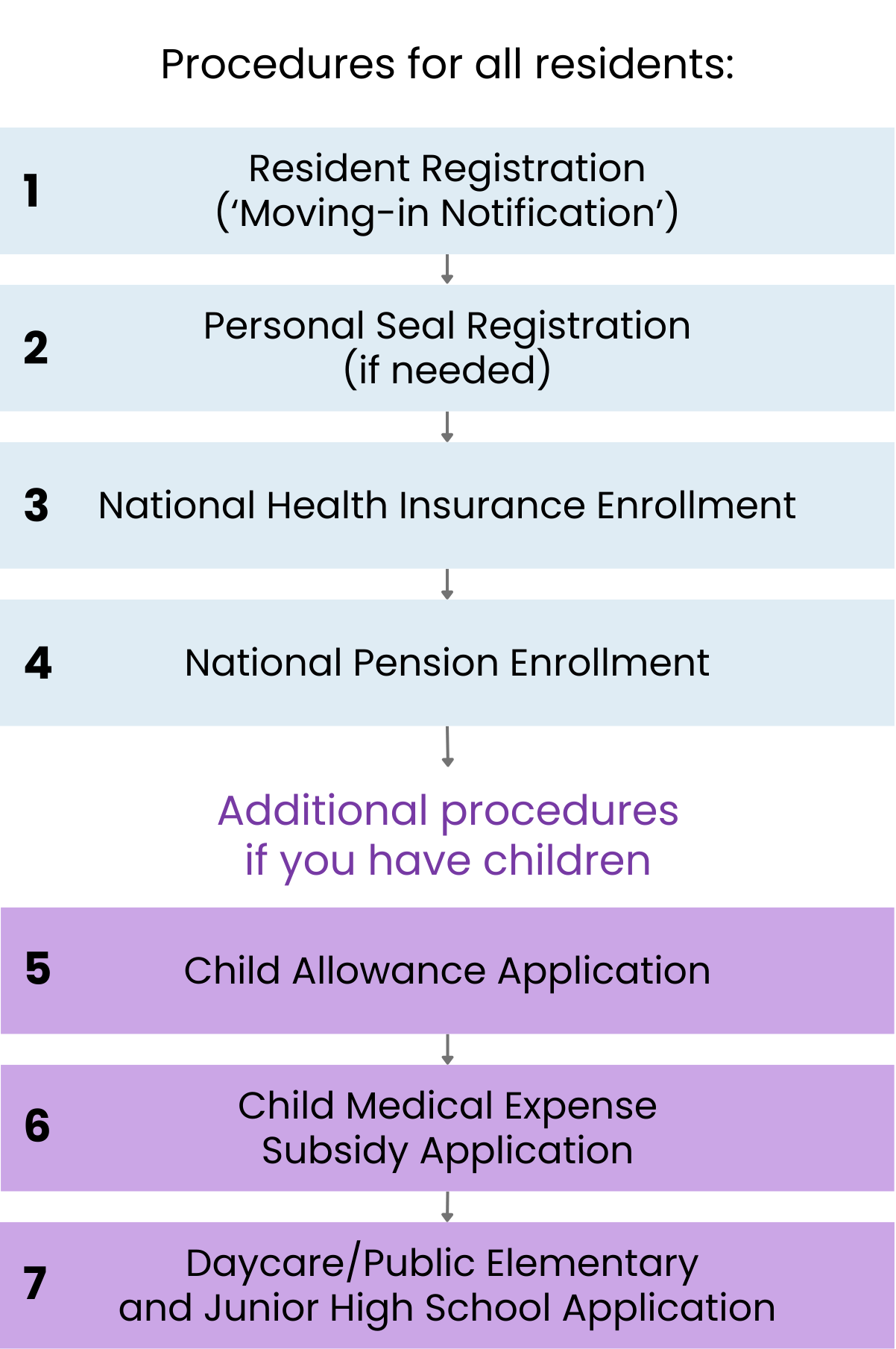
4-2. Flow of Ward Office Procedures Upon Entry to Japan
4-3. Required Items for Ward Office Procedures
- Residence Card(s)
- Passport(s)
- Documents issued by your home country proving relationship with the head of household (if you have family members living together in Sapporo)
- Personal seal (if already made)
- Japanese bank account information (if available)
- For daycare enrollment procedures, additional documents such as an employment certificate from your workplace are required
4-4. Resident Registration (Moving-in Notification)
Foreign nationals who enter Japan as mid to long-term residents must register their address at the ward office within 14 days of establishing residence in Sapporo.
Mid to long-term residents refers to those eligible for a residence card. This does not include those with Temporary Visitor status or those staying for three months or less.
When submitting your moving-in notification at the ward office, the following applies:
- If you are registering family members living in the same household, you must submit documents proving your relationship to the head of household (such as original birth or marriage certificates issued by official authorities in your home country).
- These documents must be accompanied by a Japanese translation.
4-5. National Health Insurance
Anyone living in Japan for more than three months must be enrolled in health insurance.
- If you or a family member are enrolled in company social insurance, you may be covered under that system.
- If no other insurance applies, you must enroll in National Health Insurance at the ward office.
When enrolling in National Health Insurance, you must notify the ward office within 14 days of the qualifying event (e.g., the date of moving to Sapporo or the day after leaving your previous job.)
4-6. National Pension
People aged 20-59 living in Japan must enroll in Japan’s pension system.
However:
- If you are enrolled in Employees’ Pension Insurance (“kosei nenkin”) through your employer, you do not need to enroll in the National Pension.
- If you are covered as a dependent spouse under Employees’ Pension Insurance, enrollment in the National Pension may also not be required.
Please check with your company or your spouse’s company about the availability of employees’ pension insurance.Additionally, Japan has international social security agreements with certain countries to:
- prevent double pension contributions, and
- allow pension enrollment periods in both countries to be combined.
Please check whether your home country has such an international social security agreement with Japan.
4-7. Child Allowance and Child Medical Expense Subsidy Applications
Child Allowance
If you have children, you are eligible to receive child allowance until the end of the first fiscal year after the child turns 18 (typically until March 31st of their high school graduation year).
- The amount varies depending on the child’s age and birth order.
- There are no household income restrictions for receiving child allowance.
Child Medical Expense Subsidy
This program subsidizes part of the out-of-pocket medical expenses for children from birth through high school age(approximately 18 years old).
Both outpatient and inpatient medical expenses covered by health insurance are eligible.
4-8. Daycare and School Education Procedures
If you cannot care for your children due to work, schooling, illness, or other reasons, you may be eligible to use daycare facilities.
Standard opening hours for authorized daycare centers in Sapporo are from 7:00-18:00, but extended care is available if needed due to work circumstances.
Under Japan’s early childhood education and childcare support program:
- Childcare fees for children aged 3 and older are free, regardless of household income
(food and other additional costs may apply). - Fees for children under 3 are determined based on household income.
4-9. About ‘My Number Card’
My Number is a 12-digit number used in Japan for social security, taxation, and disaster response.
Foreign nationals staying in Japan for over three months can apply for a My Number Card, which can also be used as an official form of identification.
4-9-1. Main Uses of My Number
- Receiving pension, childcare benefits, or medical services
- Sending or receiving money overseas
- Opening a bank account
- Proving your identity with an official ID
- Filing income tax returns online
- Applying online for child-related benefits or daycare enrollment
- Obtaining resident records and other certificates at convenience stores
- Serving as a health insurance card
4-9-2. How to Apply for a My Number Card
There are several ways to apply for a My Number Card.
- Apply when submitting your moving-in notification at the ward office
- Apply in person at the City My Number Card Center using the application form that will be sent to your registered address at a later date.
- Apply via smartphone
- Apply via computer
- Apply by mail
- Apply using ID photo booths (compatible models only)
- Apply at your local ward office counter in person
4-9-3. Receiving Your My Number Card and What to Bring
The card will be created by the Local Government Systems Organization. Once completed, you will receive a My Number Card Issuance Notice from the ward office. Please collect your My Number Card at the issuance location (usually the ward office) specified in the notice.
[Required items to bring]
For applicants aged 15 and over:
- My number card issuance notice
- Notification card (if you have one)
- Basic resident registration card (if you have one)
- Fee (first issuance is free)
- Identity verification documents (e.g. residence card, passport)
For applicants under 15:
(Both the child and legal representative must be present)
- My number card issuance notice
- Notification card (if you have one)
- Basic resident registration card (if you have one)
- Fee (first issuance is free)
- Child’s identity verification documents (Residence card, passport, etc.)
- Legal representative’s identity verification documents (e.g. residence card, passport)
- Documents verifying legal representation rights (e.g. family register extract,)
4-10. Interpretation Services Available for Ward Office Procedures
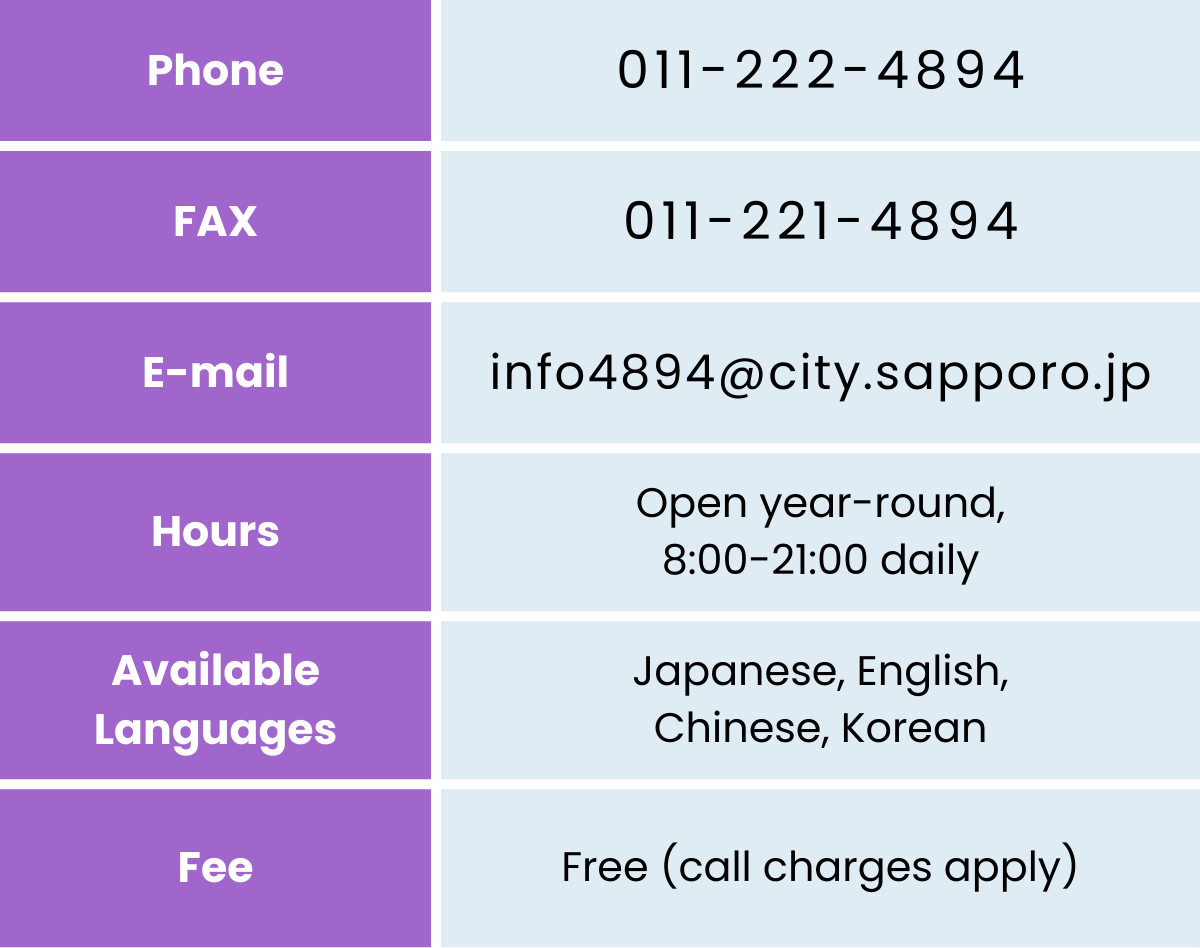
4-10-1. Sapporo City Call Center (“Chotto Oshiete” Call)
This service can be used when you are unsure which department of the ward office to contact, or when you have general questions about systems, procedures, facilities, events, or public transportation.
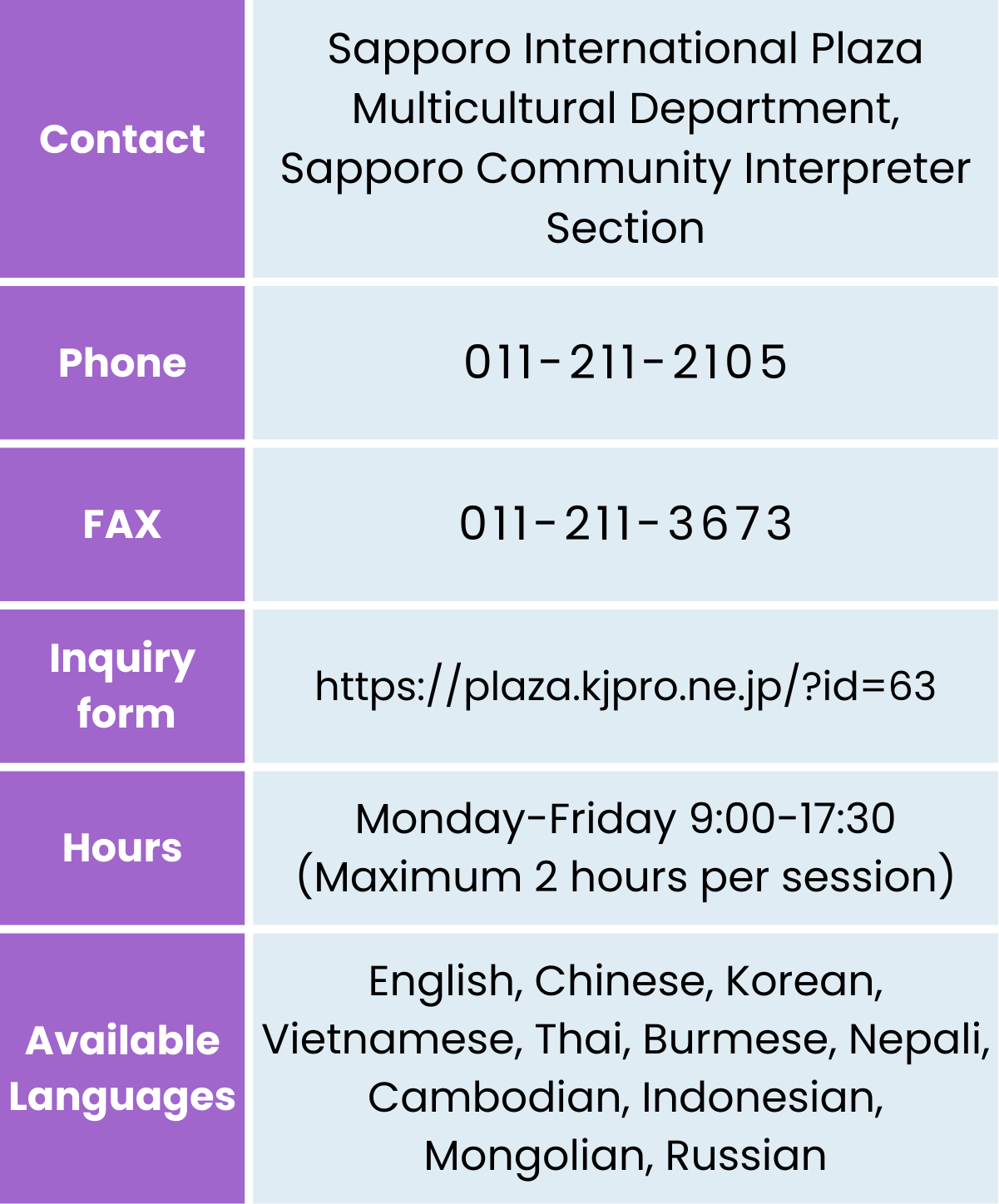
4-10-2. Sapporo Community Interpreter
Use this service when you need in-person interpretation support at Sapporo City facilities such as ward offices, schools, or daycare centers.
This service dispatches trained volunteer interpreters to help facilitate communication for foreign residents at Sapporo City facilities (schools, daycare centers, licensed nurseries, ward offices, etc.).
Advance reservation is required, so please make arrangements well in advance.
5. Housing
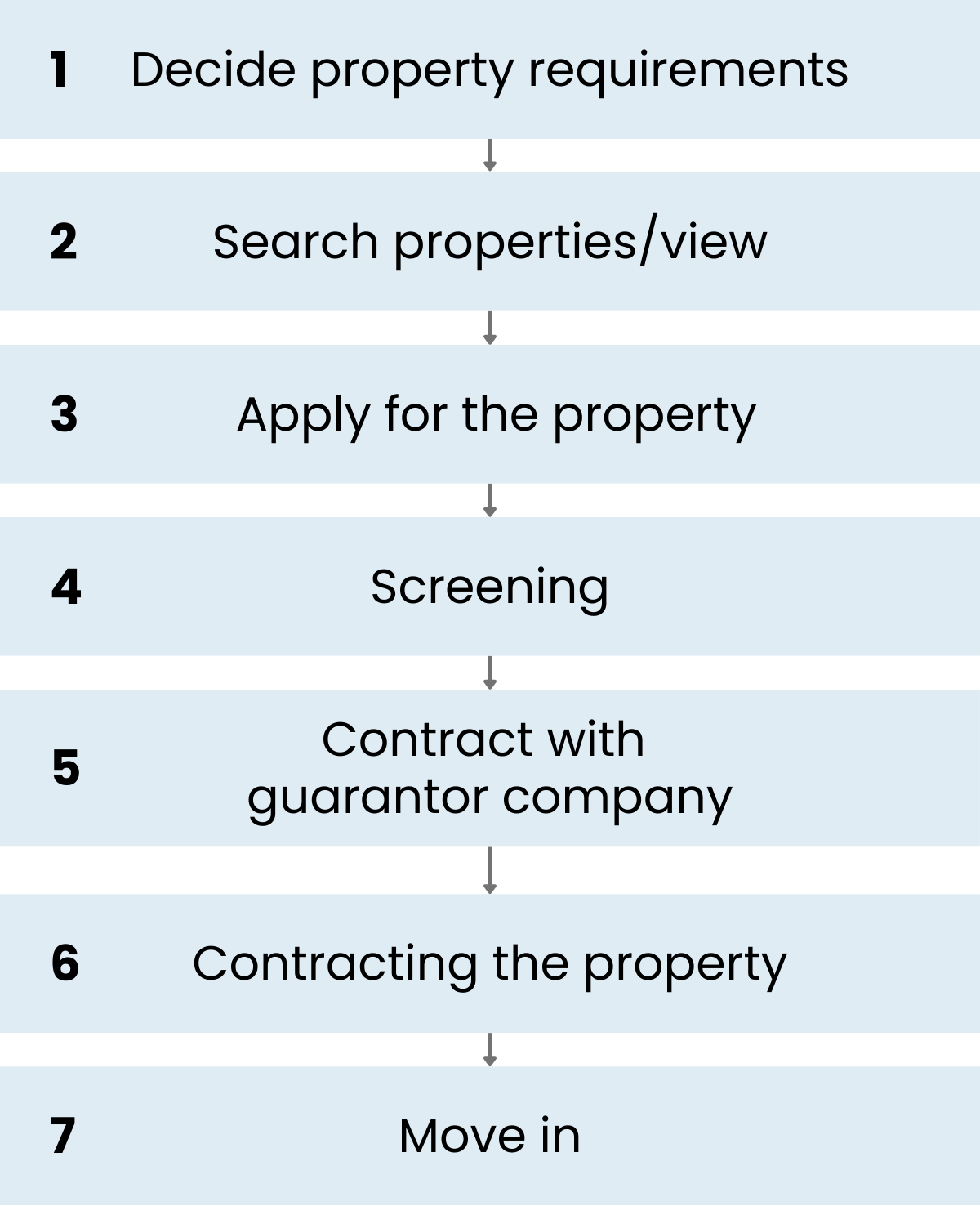
5-1. Process of Contracting Housing
Finding and renting housing in Japan typically follows the steps below. The process may differ slightly depending on the property and landlord.
5-2. Estimated Timeline for Finding Housing
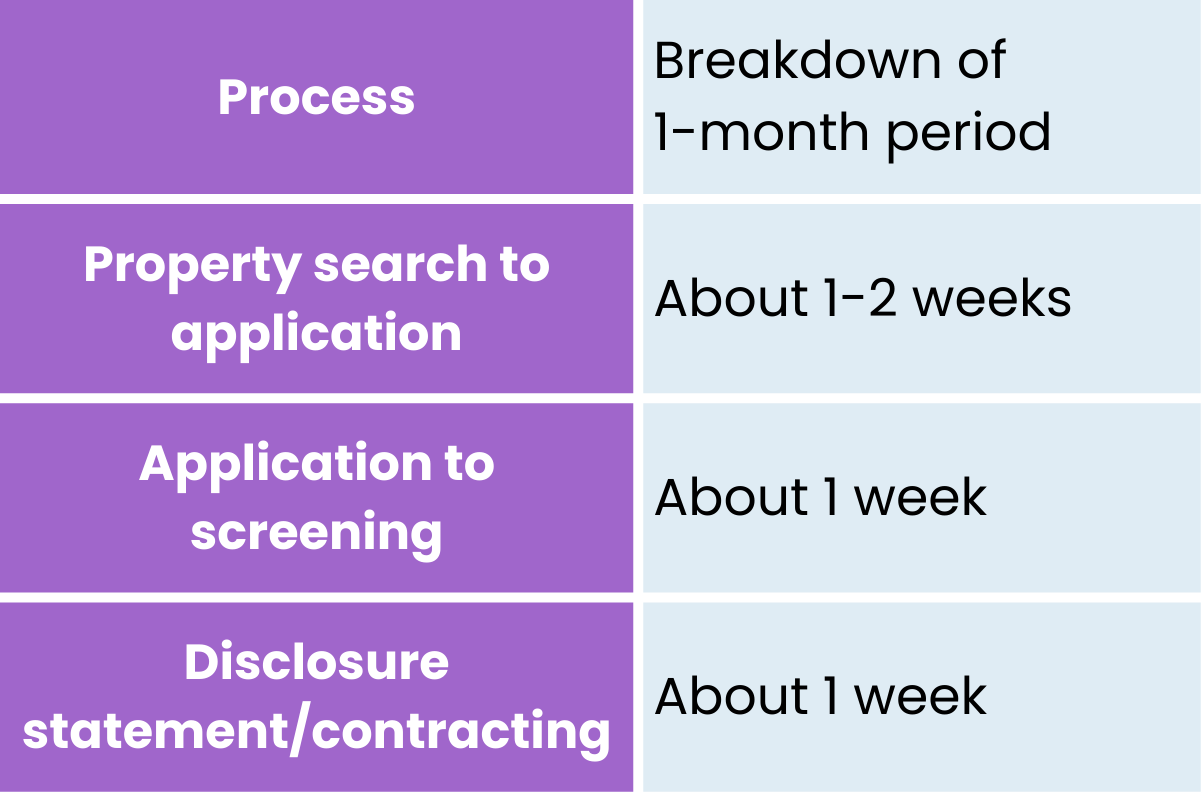
From starting your housing search to moving in, the process typically takes about one month.
If you’re looking for family-sized properties or other high-demand housing, it is recommended to contact real estate agencies more than one month in advance.
Typical timeline
5-3. Main Types of Housing
5-3-1. Apartments
In Japan, apartments (“apaato”) generally refer to low-rise rental buildings (1–3 floors) made of wood or light-gauge steel.
- Typically lower rent and management fees
- Soundproofing and security may be more limited compared to larger buildings.
5-3-2. Mansions
In Japan, the term “mansion” (manshon) refers to medium- to high-rise reinforced residential buildings, typically with enhanced security and facilities.
- Ranging from low-rise (2–5 floors) to high-rise (20+ floors) residential buildings
- Strong earthquake and fire resistance
- Features such as auto-lock entry and good soundproofing
- Higher rent and management fees than apartments
5-3-3. Detached Houses
A detached house is a standalone residence built on a single plot of land.
- Fewer rental options compared to apartments or mansions
- Often rented when previous occupants move out, rather than built specifically for rental use
5-4. Important Considerations When Choosing Housing
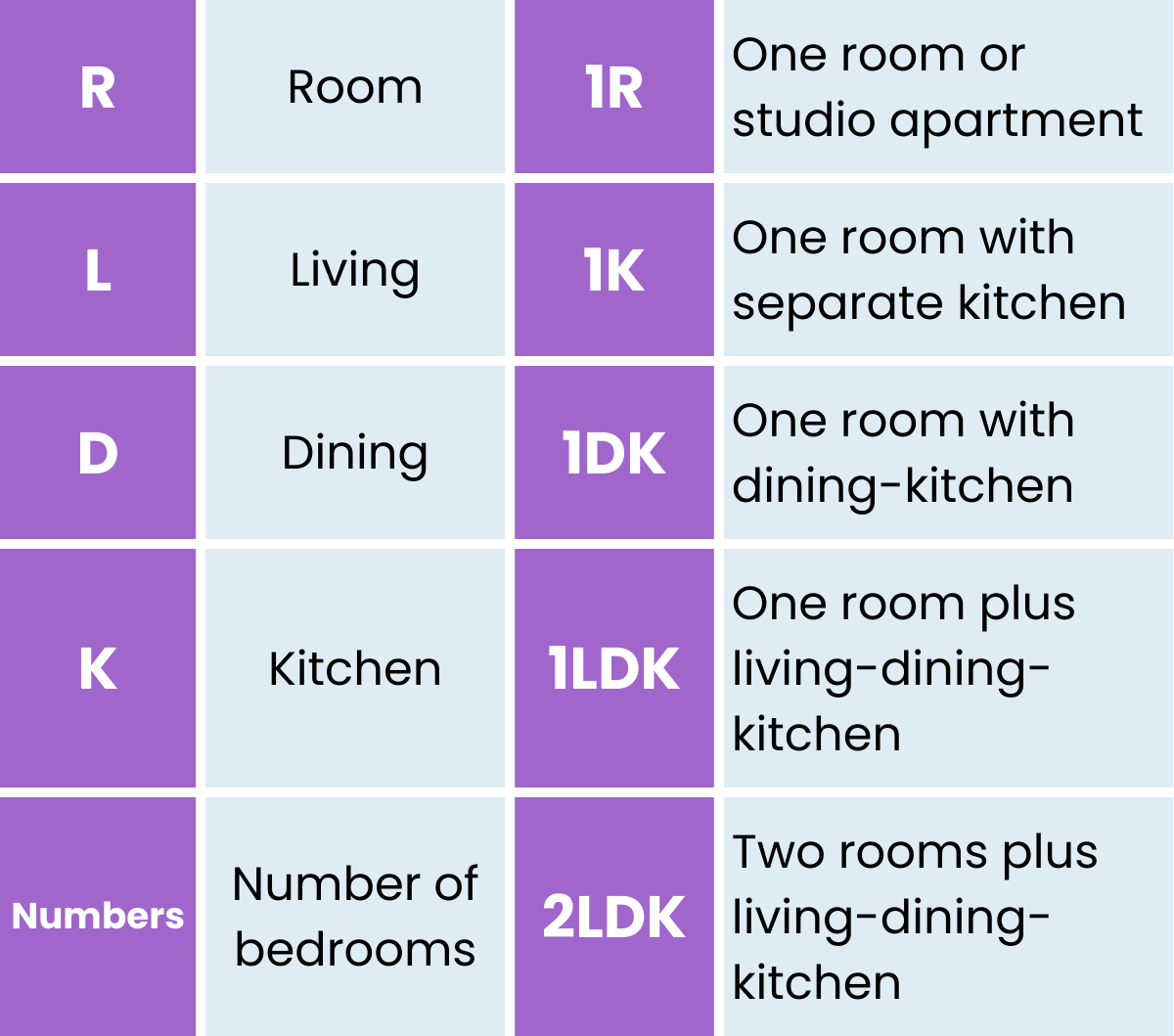
5-4-1. Floor Plan Types
When searching for properties through Japanese real estate agents or websites, letters like R, S, L, D, and K are commonly used.
These letters are used to indicate floor plans and represent the following rooms:
5-4-2. Other Important Points
- Furnishing: In Japan, it is common for rental properties to come unfurnished.
- Pets: If you want to keep pets, you need to find pet-friendly properties or obtain permission from the owner.
- Renovations and remodeling: Prior approval from the owner is required for any interior renovations or remodeling of rental properties.
- Additional occupants: When non-family members want to move into a rental property, prior confirmation from the owner is necessary.
- Move-out notice: When planning to move out, it is customary to give notice 1-2 months before the planned moving date. The notice period is typically explained in the important points disclosure at the time of contract signing.
- Early contract termination: The security deposit may not be refunded.
5-5. Initial Costs (Typical Example)
- Security deposit: Approximately 1-2 months’ rent, refundable minus any restoration costs
- Key money: Approximately 1 month’s rent, non-refundable
- Agency fee: Approximately 1-1.5 months’ rent, non-refundable
- First month’s rent: 1 month’s rent paid in advance
- Fire insurance: Varies depending on property type and insurance company
- Guarantor company fee: Varies depending on property type and guarantor
etc.
5-6. Required Documents for Rental Contracts
- Residence Card or Certificate of Eligibility (COE)
- Copy of bank passbook from Japanese or home country bank
- Photos of the applicant
- Emergency contact who speaks Japanese and lives in Hokkaido
- Japanese mobile phone number
- Personal seal
6. Sapporo City Life-Support Apps (Multilingual)
6-1. Sapporo Station Bus Navi (Sapporo eki bus navi)
Sapporo City has a well-developed public transportation network including municipal subways, streetcars, buses, and JR trains, making it easy to travel around the city.
Sapporo Eki Bus navi is a convenient service that allows users in Sapporo to search for timetables, fares, transfer routes, and even real-time bus locations for major public transportation in the city.




6-2. Sapporo City Waste Sorting App (Sapporo gomi bunbetsu)
In Japan, including Sapporo City, each municipality has detailed rules for waste disposal. In addition to sorting waste by type, residents need to obtain designated paid garbage bags, and be aware that collection days vary by district, and there are specific locations and times for disposal (in Sapporo City, waste must be taken to designated garbage stations by 8:30 AM). It is necessary to check the rules for your area.
The Sapporo City Waste Sorting App allows you to easily check information about these complex waste sorting and disposal methods. The calendar also includes a notification function, making it easy to keep track of garbage collection days in your area.



6-3. Sonae (App for disasters)
In Japan, where natural disasters such as earthquakes and floods are common, it is important to stay informed about emergency and evacuation information and be prepared for when disasters occur in order to live safely and securely.
Sonae provides emergency information about earthquakes, wind and flood damage in Sapporo City. You can also check information about evacuation sites and daily preparedness measures.
6-3-1. Information Available on Sonae
- Emergency information notification
- Risk level experience using AR
- Evacuation site notification using GPS
- Hazard maps
- Safety information confirmation
- Disaster simulation
- SOS message service
- Disaster prevention information
- AR tags (Shows direction/distance to evacuation sites using AR)
etc.