

How to Establish a Company in Japan
Establishing a company in Japan involves several legally prescribed steps, from determining basic corporate details to completing registration and post-incorporation notifications. Below is an overview of the main procedures, key preparations, and required filings.
Overview of Company Establishment Procedures
Foreign nationals who wish to establish a company in Japan must complete legally prescribed procedures, as in many other countries. While some requirements are common to other countries, such as determining basic company details, Japan has unique procedures with specified submission deadlines.
These include articles of incorporation certification, registration procedures, screening under the Foreign Direct Investment Regime (Foreign Exchange and Foreign Trade Act), and various permit and licence notifications.
When considering basic company details and office space, it is also necessary to simultaneously consider how foreign entrepreneurs will be involved in management, including residence status. Depending on the residence status to be obtained, it may be necessary to appoint a Japanese national or a foreign national holding a residence status that permits entrepreneurial activities in Japan as the company’s representative.
STEP provides guidance on preparation for company establishment, registration procedures, and post-establishment notifications, as well as introductions to various professional service providers such as judicial scriveners, lawyers, tax accountants, accountants, and offers free consultations with them.
In addition, through STEP’s unique network and Sapporo City’s ecosystem, support is provided for identifying potential representatives in Japan when foreign entrepreneurs are involved in management without residing in Japan. Please note that introductions are not always possible depending on the industry or business type. Furthermore, STEP assumes no responsibility for subsequent relationships with any Japanese representatives introduced through their services.
Before beginning company establishment procedures with the Legal Affairs Bureau or other authorities, basic company details must be determined and preparatory steps completed. The most common company forms in Japan are “Kabushiki Kaisha“(KK) and “Godo Kaisha”(GK). The establishment process for these forms can be broadly divided into three stages.
Step 1. Determining basic company details
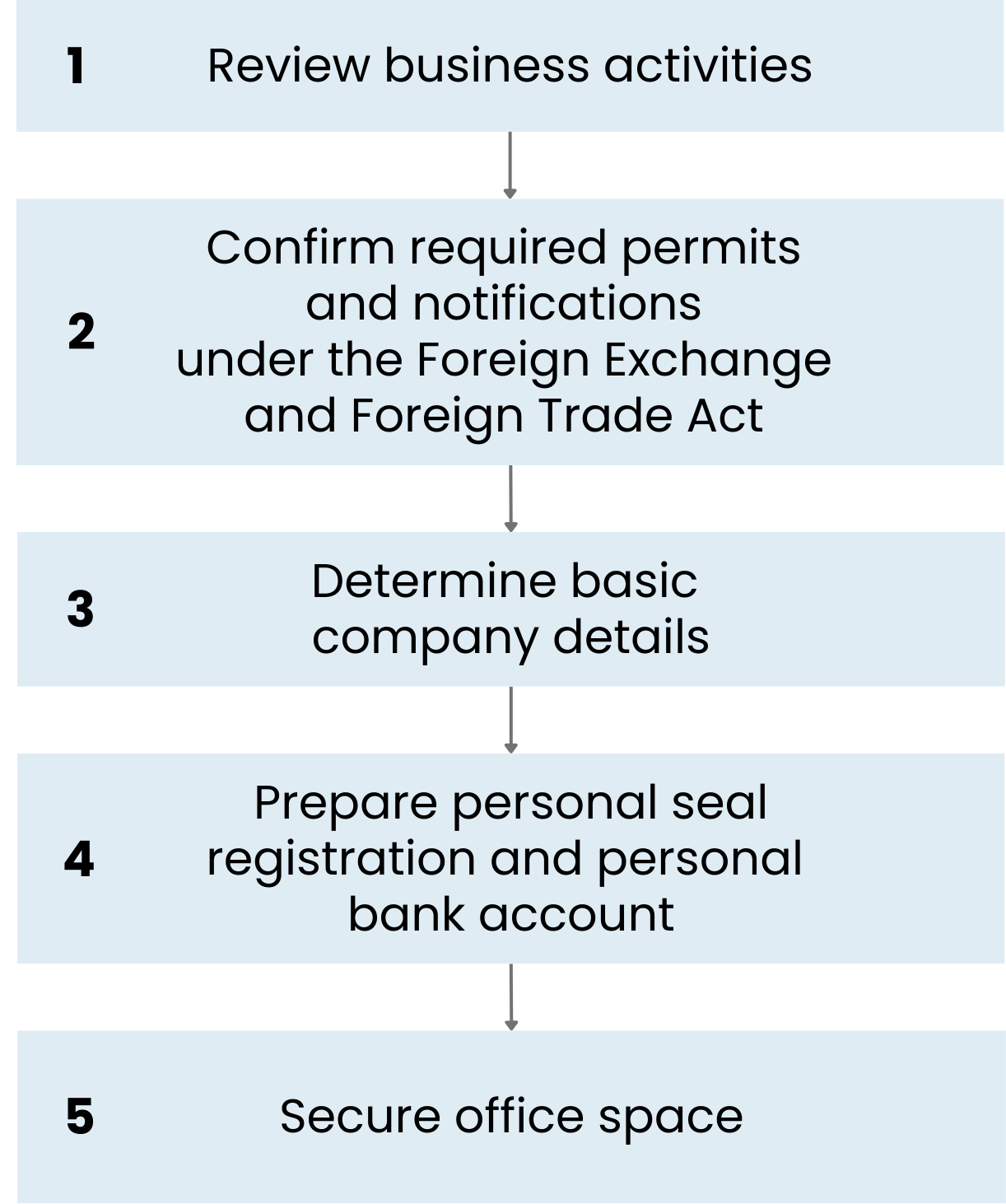
1-1. Overview of Pre-Incorporation Preparation
1-2. Basic Company Details to be Determined
- Business purpose
- Company name
- Company structure (KK, GK or other)
- Head office location (office lease agreement)
- Date of establishment
- Fiscal year
- Method of public notices
- Amount of capital
- Investors
- Incorporators (for KK only)
- Composition of officers and shareholders (for KK only)
1-3. Recommended Preliminary Research and Preparation
- Verify industry-specific permits and Foreign Exchange Act notifications (Pre/Post-filing)
- Understand characteristics of different company structures
- Check the availability and legality of proposed company name
- Create and register personal seal
- Ensure a personal bank account is available for capital deposit
- Search for and secure office space
1-3-1. Permits and Notifications under the Foreign Exchange and Foreign Trade Act
Some business activities require permits or licenses from administrative authorities. Operating without the required permits may result in business suspension or fines, so it’s essential to verify requirements in advance.
While permit applications are generally submitted after company registration, the application authorities, requirements, and necessary procedures vary by business type. It is therefore important to conduct research in advance.
Additionally, under the Foreign Exchange and Foreign Trade Act (hereinafter referred to as the Foreign Exchange Act), foreign investors must submit prior notifications or post-investment reports when making direct investments in Japan, to assess whether the target industry poses any national security concerns.
Whether a prior notification or post-investment reporting is required depends on the industry and should be confirmed in advance.
1-3-2. Company Structures – Key Differences Between Stock Companies (KK) and LLCs (GK)
While four types of companies can be established in Japan today, the most common forms are Stock Companies (“Kabushiki kaisha” or KK) and Limited Liability Companies (“Godo kaisha” or GK ).
KKs have advantages in terms of fundraising and going public, making them suitable for businesses of various sizes.
However, depending on the scale and nature of the venture, some may choose a GK for its lower establishment costs and easier decision-making process. It is important to understand the characteristics of both and choose the company structure that best aligns with your business activities, scale, and future growth plans.

Step 2. Preparing and Applying for Corporate Registration
2-1. Procedures of Corporate Registration Preparation and Application

2-2. Required Preparations Before Corporate Registration
- Create articles of incorporation
- Certify articles of incorporation (KK only)
- Capital payment (using a Japanese personal bank account or overseas branch of a Japanese financial institution’s account)
- Determine matters regarding shares issued at incorporation (KK only)
- Create corporate seals (one set: representative seal, company name seal, and bank seal)
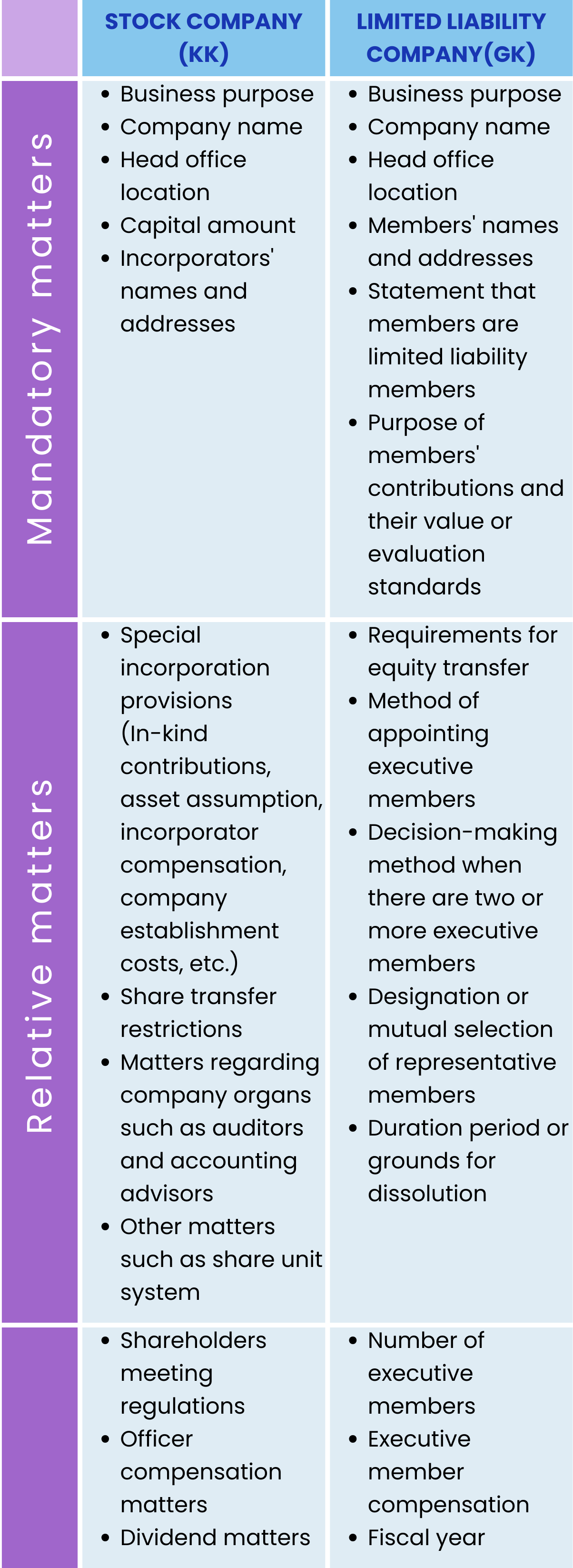
2-3. Required Matters in Articles of Incorporation
2-4. Required Documents for Articles of Incorporation Certification (KK Only)
- 3 copies of Articles of Incorporation
- One seal registration certificate for each incorporator (issued within 3 months)
- Registered seals of all incorporators
- Declaration of beneficial owners
- Notarization fees
2-5. Main Documents Required for Registration
For Stock Companies (KK)
- Registration application form
- Revenue stamp payment form
- Seal registration form
- Matters to be registered
- Articles of Incorporation
- Directors’ letters of acceptance
- Document certifying capital payment
- Seal registration certificate or signature certificate
Documents required in some cases (KK)
- Incorporators’ resolution
- Representative director’s letter of acceptance
- Auditors’ letter of acceptance
- Seal registration certificates for all directors
For Limited Liability Companies (GK)
- Application for registration of establishment
- Revenue stamp payment form
- Articles of Incorporation
- Document certifying determination of representative member, head office location, and capital amount
- Representative member’s letter of acceptance
- Seal registration certificate or signature certificate
- Document certifying capital payment
- Representative member’s certification of stated capital amount
2-6. Other Preparations Required in Advance
- Consultation with judicial scrivener (for preparation of Articles of Incorporation and registration documents)
- Creation of corporate seals (one set: company name seal, representative seal, and bank seal)
- Obtaining a signature certificate, where required
2-6-1. Signature Certificates
A signature certificate is issued by the authorities of a foreign national’s country of citizenship to certify that a signature belongs to the individual.
For foreign nationals residing overseas or those on short-term stays in Japan who wish to start a business in Japan, signature certificates are used in place of registered seals and seal registration certificates, as they cannot obtain resident registration due to lack of residence status.
Issuing Authorities
- Administrative agencies in the foreign national’s home country
- Notaries public in the home country
- Home country embassies in Japan or in country of residence
Information Included
- Name
- Address
- Date of birth
- Statement certifying that the signature on the certificate is genuine and belongs to the individual
Step 3. Post-Incorporation Procedures
There are six major procedures after company incorporation (two of which are only required if there are employees at the time of establishment). As each procedure has different submission requirements and deadlines, these need to be confirmed in advance.
In addition, notifications for permits and post-investment reporting under the Foreign Exchange and Foreign Trade Act may also be required.
3-1. Overview of Post-Incorporation Procedures
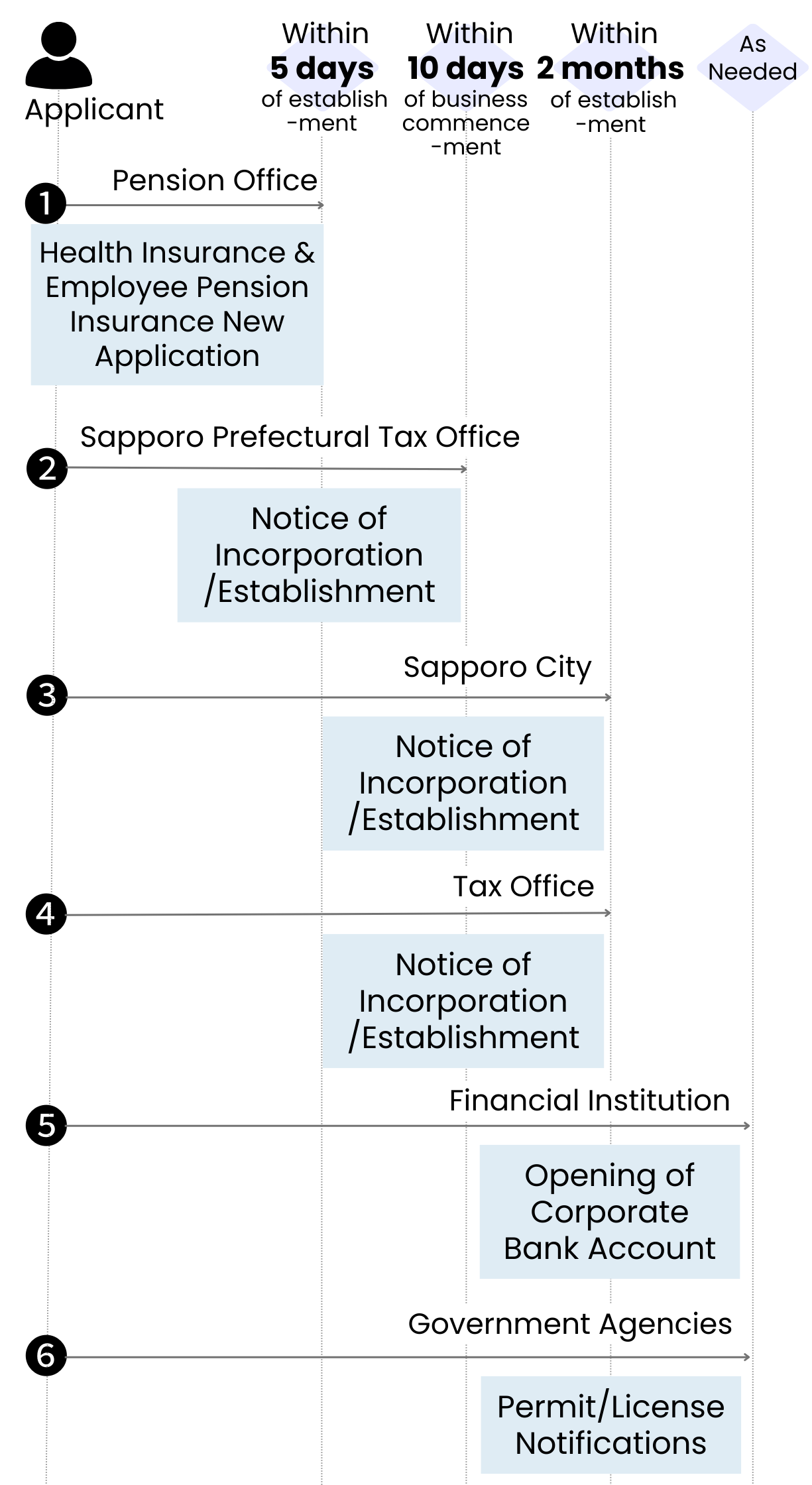
(*Only listing procedures required for all companies)
- Pension Office:
Health Insurance and Employee Pension Insurance New Application (within 5 days of establishment) - Prefectural Tax Office (Sapporo Prefectural Tax Office):
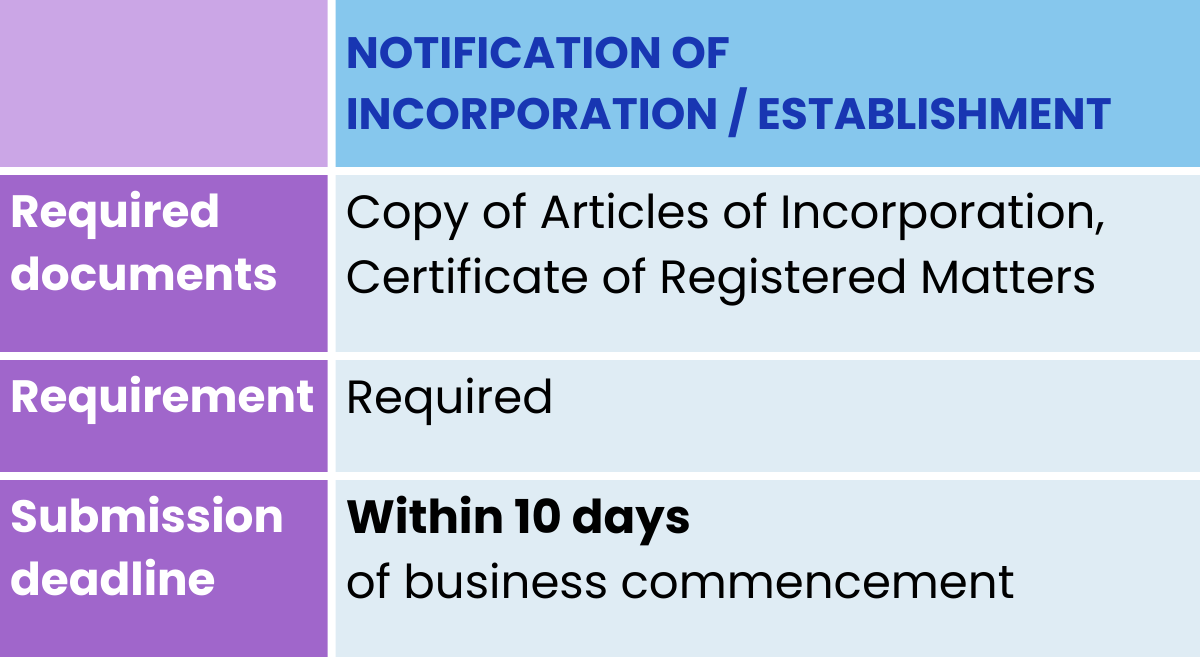
Notice of Incorporation/Establishment (within 10 days of business commencement) - Prefecture (Sapporo City):
Notice of Incorporation/Establishment (within 2 months of establishment) - Tax Office:
Notice of Incorporation/Establishment (within 2 months of establishment) - Financial Institution:
Opening of Corporate Bank Account (as needed) - Various Government Agencies:
Permit/License Notifications (as needed)
3-2. Common Procedures Regardless of Employee Status
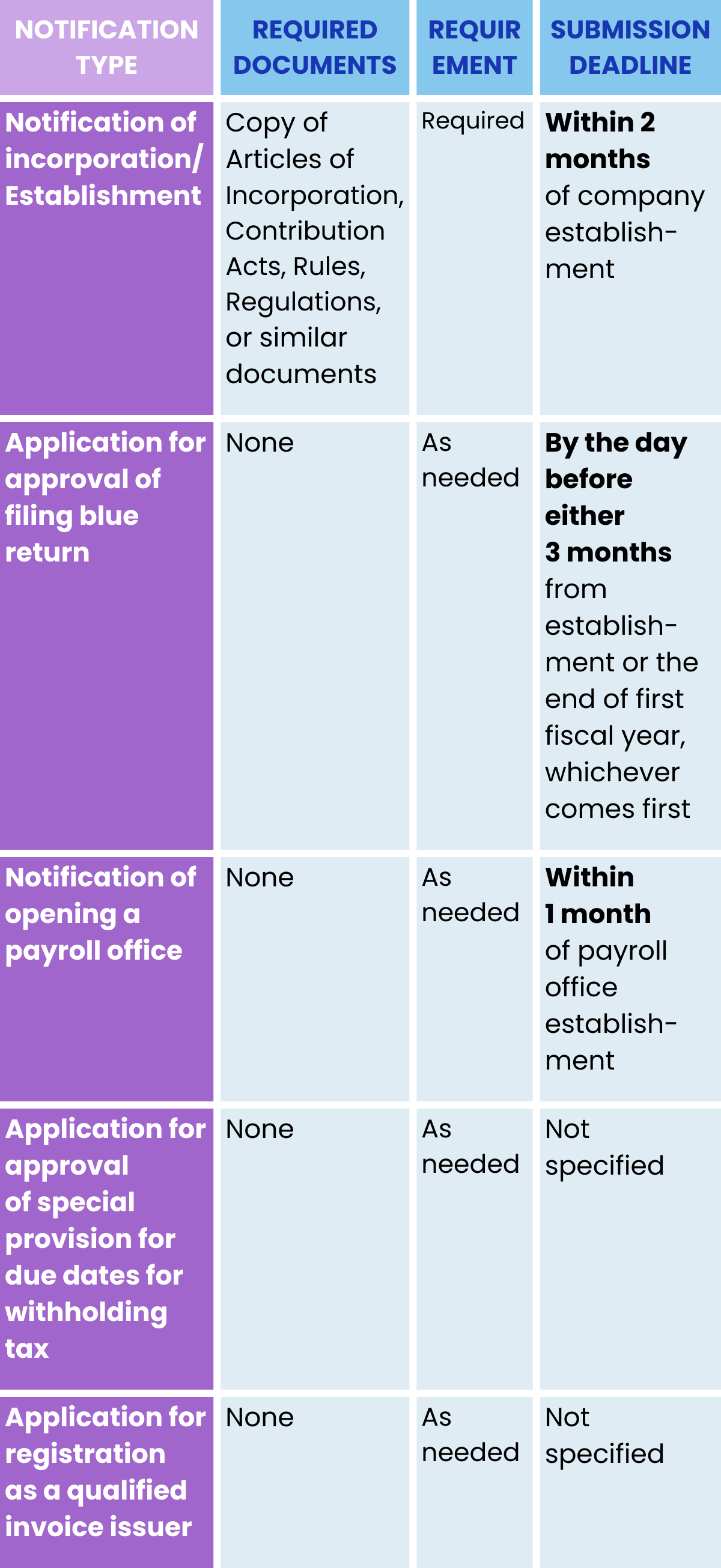
- Tax Office: Corporate Tax and Consumption Tax (Invoice system)
- Prefectural Tax Offices/Municipal Offices: Corporate Inhabitant Tax and Enterprise Tax
- Pension Office: Health Insurance and Employees’ Pension Insurance Enrollment
- Opening a Corporate Bank Account
- Submit notifications for permits and licenses to relevant government agencies
Submit permits and licenses to relevant government agencies
3-2-1. Notifications for Tax Office
3-2-2. Notifications for Prefectural Tax Office (Sapporo Prefectural Tax Office)
3-2-3. Notifications for Municipal Office (Sapporo City)

3-2-4. Notifications for Pension Office

3-3. Procedures Required Only When Hiring Employees at the Time of Company Establishment
- Labor Standards Inspection Office: Labor Insurance
- Hello Work (Public Employment Security Office): Employment Insurance Notifications
3-3-1. Notifications for Labor Standards Inspection Office
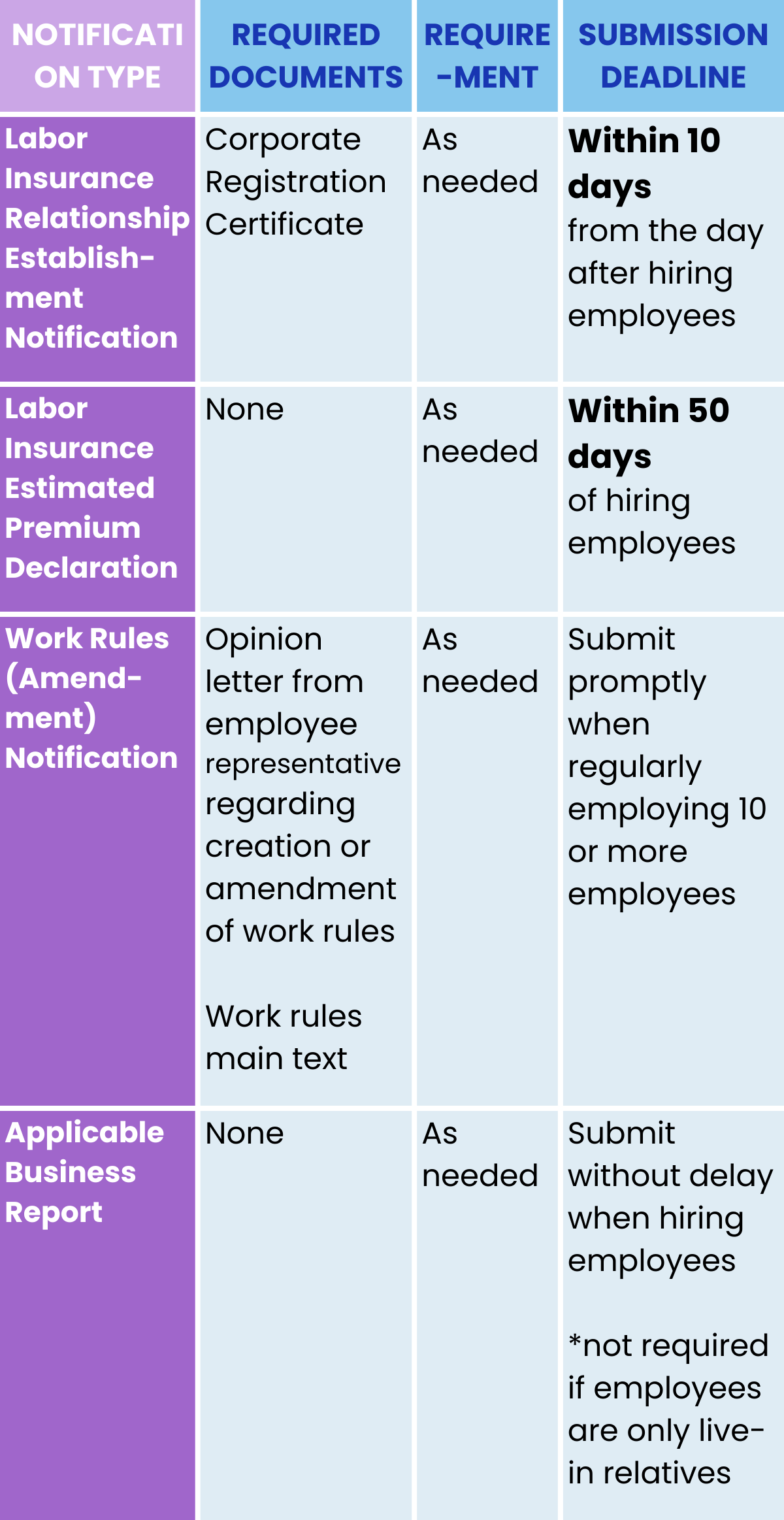
3-3-2. Notifications for ‘Hello Work’

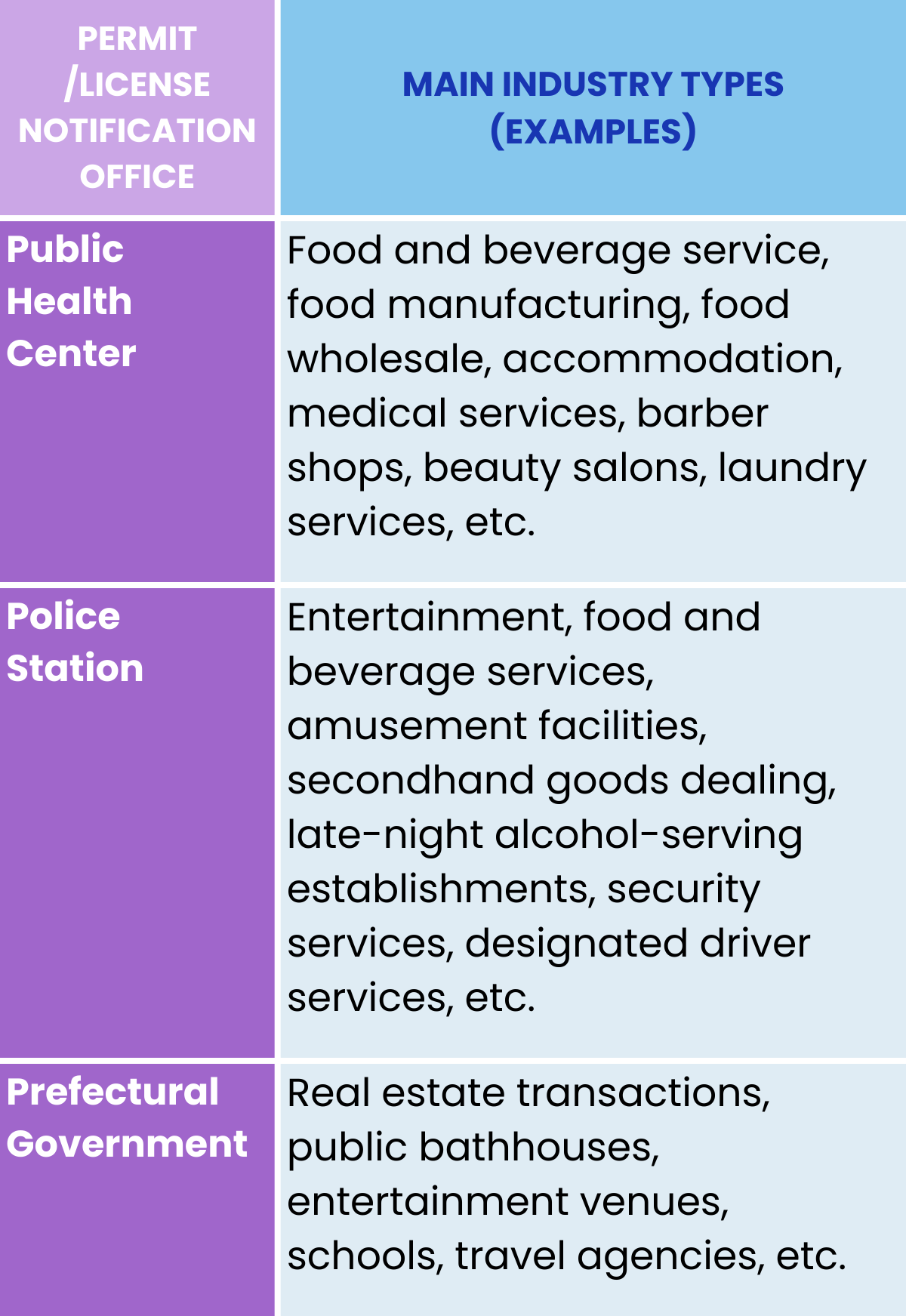
3-4. Notifications of Permits and Licenses
The main offices for permit applications are the Health Department, Police Station, and Prefectural Government Office, but submission locations and deadlines vary by industry type. Some industries may also require notifications to tax offices or transportation bureaus, so verification is needed for each industry type.